Where your fear is, there your task is.
Carl Jung

WHAT IS POLYAMORY?
Polyamory is a consensual intimate relationship involving more than two people. The practice has existed since time immemorial, but the term itself—from the Greek poly and Latin amor, meaning “many loves” or “many types of love”—is a fairly recent Americanism (some proponents prefer the term “consensual nonmonogamy” or simply “nonmonogamy”). The polyamorous unit, known as the polycule, contains any number of people of whatever sex or gender. The simplest polycule is the triad or “throuple” (three + couple): three people sharing each other lovingly and sexually and perhaps living together. Or two couples may similarly merge their lives under one roof. This may go beyond mere companionship and include not only life in the bedroom but shared responsibilities such as cooking, cleaning, and vacationing together. In contrast to the one-off or occasional threesome, or swinging couples, there is a mutual effort to cultivate and deepen the relationship, to make it stick and take it as far as it goes.
There are as many types of polyamorous relationships as there are people in them. This variety is upheld as vital to the definition of polyamory. A polycule may be “closed” (sexually committed and exclusive) or open and evolving, with people entering and leaving at will and by mutual agreement. There is no limit to the size of a polycule or the number of partners who become involved with each other, serially or simultaneously. The ties between individuals within the same polycule may be relatively stronger or weaker, and some may have connections with other polycules. Some or all may live separately (their jobs, locations, and current homes may necessitate this) but living together is the logical outcome. For some polyamorists, the attraction of communal living is the whole point and purpose of polyamory. Communal living does not necessarily involve sex. People have widely divergent sexual drives and needs, these can change over time, desire can shift among different people, and love and intimacy may be expressed in nonsexual ways.
Polyamory may stop here, contenting itself with the communal meshing of several families and their children in the daytime, while each nuclear unit retreats to its private sphere at night. Or it may venture further. If two couples willingly go to the length of mingling their daily lives and perhaps their finances as well, if mutual fondness and compatibility have brought them this far, it’s not such a stretch to imagine them popping open another bottle of wine and interacting on a more intimate level—romantically and sexually. Indeed, to become “nesting partners” may have been the purpose all along and the reason why they sought each other out in the first place.
Many practitioners hold that polyamory by definition requires some degree of intercouple sexual engagement. Or if not, then a deepening intimacy corresponding to the degree of daily life shared together. A community in which members enjoy the economic and social conveniences of communal living while remaining strictly monogamous in the territory of their bedrooms would not generally be regarded as polyamorous. Polyamory implies a conscious decision to break free of the strictures of conventional monogamy and open up the dyadic couple to intimacy with new people.
A different sort of arrangement is the “primary” couple that seeks the pleasures of “secondary” romantic partners or lovers without having to sacrifice the monogamous family structure, responsibilities (including childrearing), and finances of their own household. To the extent that they experiment with integrating secondary relationships into their daily lives, they could be said to be polyamorous. If, on the other hand, time spent with their secondaries is compartmentalized into no more than discrete sex sessions, they would be better described as swingers. Polyamorists unpack the inherent potential of swinging into full-blown, longer-lasting relationships that involve more than just sex. For example, they might chip in to pay for expensive medical care for a person in their polycule. But this is not in any sense a trivialization or rejection of sex. For many polyamorists, sex flows naturally from intimacy, and each new intimacy invites sex. Some may consider the task of integrating a single individual or couple into their lives on a long-term basis, without even considering the question of sex, to be a worthwhile and satisfying enough endeavor. For others, adding sexual variety to their lives is the driving factor.
There are no sexual strictures other than what is consensually worked out by the particular polycule. To make their relationships work and grow, polyamorists consciously strive to tamp down jealousy. It is understood that polyamory and jealousy are incompatible, and if one cannot learn to tame jealousy one does not become a polyamorist. I stress the word “tame” here to underscore that jealousy is a powerful emotion akin to anger and fear and cannot be entirely eliminated but can be mollified and put in its place (or, alternatively, understood in a productive and creative way: jealousy as a device or tactic for periodically reinvigorating a relationship with drama). A conceptual tool for managing jealousy is a word coined by polyamorists to denote its opposite, “compersion” (compassion + immersion), which means to take pleasure in your partner’s attraction to another person—and even to love that new person as well. As the description states in Marie Thouin’s What Is Compersion?: Understanding Positive Empathy in Consensually Non-Monogamous Relationships: “By disrupting the idea that jealousy is the only valid response to intimacy beyond monogamy, the existence and practice of compersion builds the foundation for a completely new paradigm of loving relationships.” If you understand the idiom to “think outside the box,” polyamory is thinking outside the box of jealousy.
Among the growing library of articulate publications for the polyamory movement, Ryan and Jetha’s Sex at Dawn: How We Mate, Why We Stray, and What It Means for Modern Relationships is probably the best known. But long before the term was coined two books spelled it all out. In The Origin of the Family, Private Property and the State (1884), Friedrich Engels enumerated in cogent detail the many alternatives to bourgeois marriage which the tribal or communal unit had at its disposal, as evidenced in non-Western cultures throughout the ages (as these alternatives are too numerous to list here, you’re directed to chapter two in Engel’s book). And there was German psychoanalyst Erich Fromm’s stunningly simple insight in The Art of Loving (1956), that contrary to the conventional notion of love (and its destructive obverse, jealousy) as a commodity of limited quantity easily squandered unless saved up for the exclusive “chosen one,” love is an infinite resource with no inherent limit to the number of people it can be showered on, not only over the course of one’s life but at one and the same time. As Jessica Fern in Polysecure: Attachment, Trauma and Consensual Nonmonogamy adds,
People practicing CNM [Consensual Non-Monogamy] typically embrace the following ideas and principles: love is not possessive or a finite resource; it is normal to be attracted to more than one person at the same time; there are multiple ways to practice love, sexual and intimate relationships; and jealousy is not something to be avoided or feared, but something that can be informative and worked through.
A note on terminology: many poly authors conflate sex with intimacy and for perhaps understandable reasons play down mention of “sex” in and of itself. I believe it’s important to distinguish between sex and intimacy, otherwise we are allowing our tradition of puritanical morality to set the tone by default. This tradition holds that sex is only legitimate when combined with intimacy or love and suspect when enjoyed and celebrated for its own sake. I define intimacy between adults as emotional closeness that (when they are not relatives) commonly leads to sex.
POLYAMORY DISTINGUISHED FROM POLYGAMY
Polyamory must be sharply distinguished from the archaic practice with which it is often confused and conflated, namely that of men marrying multiple wives, otherwise known as polygamy (or polygyny). Polyamorists condemn this sexist and misogynistic practice wherever it occurs, whether among present-day Mormons in the U.S. or in any historical context, such as Imperial China, when men of means could buy and sell as many concubines as they could afford (more charitably, a wife would secure a concubine for her husband if she herself proved barren). The practice is objectionable, of course, because the wives have little or no say in the arrangement, and they are expected to be sexually available at the husband’s whim or on a rotational basis with no consideration for their own emotional and sexual needs, much less any freedom to pursue other men on an equal basis. Polygamy was outlawed in China in 1949 and is today viewed as a sorry, feudalistic legacy of the past.
The idea of polyamory, on the other hand, remains largely unknown in many traditional societies. In today’s China, translation dictionaries either lack the word or equate it with polygamy: yifu duoqi, “one husband, many wives.” However, the reverse situation, that of polyandry (yiqi duofu or “one wife, many husbands”), exists in a fashion among the Mosuo, an ethnic minority in Yunnan Province, who practice a form of matriarchal kinship in which women control the family line and young women may freely take on as many male lovers or “husbands” as they wish. Polyandry is officially tolerated by the Chinese Government—as long as it stays within this ethnic group.
Another form of polyandry widespread in Imperial China and (rumor has it) still found to occur discreetly, is zhaofu yangfu, “enlisting one husband to support the other.” The poor people’s answer to polygyny, it referred to an impoverished couple’s inviting a better-off single male to move in with them and share the wife’s bed in exchange for his labor or monetary assistance. Typically, the arrangement was only for mutual convenience, but as Matthew Sommer documents in Polyandry and Wife-Selling in Qing Dynasty China, in many instances the wife was sexually fulfilled, transforming the relationship from a polyandrous to a “polyamorous” one (they didn’t quite get compersion, however, and things could take a violent turn if the wife transferred her affection to the new partner). While the throne forbade polyandry and punished it harshly when discovered, local authorities and communities tended to look the other way. Reasonable people grasped that for the poor it was a logical response and solution to economic distress or in times of famine.
People who furtively practice this form of polyandry today likely don’t know the word for it, much less the notion of polyamory. In any case, both polyandry and polygyny are outlawed in the PRC, and it’s illegal as well for a mixed-sex group of three or more people to be naked together, even in the privacy of their homes (the “group licentiousness” law was reimposed in 2012 after the “Professor Ma” affair, who was caught organizing orgies and made an example of). That pretty much rules out all forms of nonmonogamous lifestyles, at least involving sex.
Another historically attested practice that shares a bit in the spirit of both polygamy and polyamory is sex hospitality, which is when a male host offers his wife to his male guest for the night. It occurred among the White Lotus rebels in China in the early nineteenth century (Naquin, Millenarian Rebellion in China). Around the same time on the other side of the globe, Lewis and Clark were repeatedly urged to allow the wives of the Native American chiefs they met on their journey across the U.S., into their bed, though Victorian sensibilities prevented them from partaking (Ambrose, Undaunted Courage). I have not researched sex hospitality in depth, but I would guess that it has occurred among discreet enthusiasts in all societies up through the present. I’d like to see it catch on, but to put everything on equal basis, wives would need to offer their husbands to their female visitors.
If your male host offers you his wife, or your female host her husband, for the night, and the next morning over breakfast they both have a glow on their face and enthusiastically ask you how it was, you’re beginning to understand polyamory.
Once monogamists acknowledge that polyamorists are not polygamists, we can get to the real issue at hand—monogamy itself, that deeply entrenched Ur-faith. Polyamorists have no desire to take anyone away from their partner. They seek to be legally allowed to practice among themselves something they believe to be superior and thus sway by example. If they happen to invite you and your partner to join them, don’t be offended but consider yourself blessed. Monogamy is closed and authoritarian. It is limited to the dyad and prohibits intimate or sexual relations with people outside of the dyad. Polyamory is open and democratic; it enables and encourages the natural desire to enter new relationships while being loyal to existing ones. It affirms that the quality of sex life withers when a couple is confined to each other alone and blooms with the infusion of fresh blood. It affirms the lifelong need to love—and fall in love with—more than one person.
However carried out in practice, the very idea of polyamory is existentially threatening to monogamy; it seems to threaten love itself. This is perhaps what many people find the hardest thing to grasp. Doesn’t falling in love with a new person necessitate falling out of love with one’s existing partner? How can the burning intensity of love kindled by two people survive the intrusion of a third person without being dispersed or snuffed out? If, on the other hand, we can imagine the couple as kindling a wick, we can imagine three, or four people together kindling an even brighter wick.
What’s radical isn’t so much the more daring forms of polyamory, such as the sexually communal household, “whose members have decided that in the event of pregnancy, all the men will have parenting duties,” and “the woman will get a paternity test to determine the biological father,” as Veaux and Rickert describe in More Than Two: A Practical Guide to Ethical Polyamory. You read that right: in the more adventurous multiparent families, if pregnancy is on the agenda, it may not be immediately evident who the father is. Thanks to DNA technology, this question can be resolved quickly and precisely. But does it in fact matter, if the children are brought up communally? In some families it may, in others it may not. This is ultimately what is most radical and threatening to conventional society about polyamory: the fluidity and elasticity of it. This is terrifying to monogamy, which is rigid. Polyamory is negotiable and allows for sexual interaction, or not, as the parties are so inclined; monogamy is non-negotiable.
There is no agreed-upon set of rules or requirements for polyamory, only the principle that human relationships can be more fulfilling and enlivening when three or more people engage in the same ways as monogamous couples do. Polyamory includes monogamy in that it accommodates couples who consider themselves monogamous but happen to be polycurious and experimental enough to loosen the shackles of sexual exclusivity. But to arrive at this insight nonetheless constitutes a momentous, radical conceptual breakthrough: the realization that monogamy is no longer needed.
The best way to understand monogamy is to see it for what it is: a faith, a dogma, a religion—the religion of Monogamism. Monogamism has such a grip on society because it underlies all patriarchal religions. It even ensnares atheists. It’s the Ur-religion—the original, primeval religion—molding itself from an early age to your very conception of reality so that you are enjoined to follow its dictates without realizing it. You believe in exclusive happiness with one lifelong partner for no other reason than you’ve always believed it, and your parents believed it. Yet it’s a belief as illusory, arbitrary, and contrary to nature and reason as belief in any of the garden-variety deities proffered by organized religion, distinguishable only by the different style of robes worn by their prophets.
This is not a wholesale rejection of monogamy. It’s a consideration of alternative ways of organizing families that may work better for some people, possibly most people. Polyamory is not for everyone. Many monogamous couples may truly be sufficient unto themselves and would find the notion of tinkering with their domesticity simply redundant. The love of two people is a beautiful thing. More power to the lucky few who find their soulmate and stay committed happily ever after! Nor should we discount the many who have difficulty making it through the day, for whom life is complicated enough and would find the prospect of venturing beyond monogamy exhausting.
Polyamory is an option, not an imposition. Monogamy, by contrast, is equivalent to dictating that, for obscure ethical or cultural reasons, once you choose your major in college you must accept a lifelong career in the same and can only get out of it in a court of law, or that to preserve a neighborhood’s pride in its long-standing residents, you may never move out of your first purchased home, or that for the sake of shielding the citizenry from corrupt foreign influences you aren’t allowed to travel abroad. In any other context, this would be totalitarianism. Yet you, as a monogamist, would embrace totalitarianism in marriage as common sense and blithely count yourself among the faithful.
JEALOUSY AND OTHER OBJECTIONS
Objections to the idea of polyamory are twisted together in a tight bundle of fear. Let’s return to jealousy before moving on to other concerns. Ask almost any person about jealousy and they’ll say it’s completely natural, uncontrollable, and a justifiable excuse for violence (you won’t get off the hook for murdering your rival, but you may be sentenced more leniently for the “crime of passion”). Consider two scenarios: 1) You catch your spouse (or partner) in an affair red handed. 2) Your spouse asks for your permission to date or sleep with someone they have their eyes on. Both cases would be shocking enough and cause for jealousy. Yet I think most would agree that directness and honesty is more palatable than finding out your spouse has been cheating on you. And it would be more palatable still if your spouse made every effort to reassure you that their attraction to another is not because you are not good enough for them, and they have no intention of abandoning you or the family. The second scenario thus separates out the worst aspects of discovering an affair—the secretiveness and dishonesty, and the seeming breach of the family hearth—and enables us to analyze the problem of jealousy clearly and soberly, in isolation from its associated aspects.
Although jealousy often leads to rage, it does not follow that it must lead to rage, any more than an affront to one’s honor calls for a showdown with pistols, as in the old tradition of the duel. In The Politics of Ecstasy (1968), psychedelic guru Timothy Leary condemned all the emotions attached to love, including love itself: “What psychologists call love is emotional greed and self-enhancing gluttony based on fear.” Leary had been a noted clinical psychologist at Harvard University (before he was fired for doling out LSD to grad students), had specialized in interpersonal and relationship behavior and knew whereof he spoke. What he meant was love and passion tend to get people worked up into hysterical states even before jealousy enters the picture. When it does, the mixture is toxic and destructive of the even-keeled sanity that wisdom teaches. There is absolutely no reason for rage, only reflection, appropriate (nonviolent) action, and maybe even humor. Leary was not advocating that people become monks or withdraw from loving relationships but rather to be centered, relaxed, and capaciously minded in love, even regard it with humor. “All human activities, including the scientific,” he added, “are funny.” That includes jealousy, which we tend to take much too seriously, just as we take sex too seriously. Sex is fundamentally a form of comedy, not tragedy.
No one wants to be in a competition involuntarily, as when the person you had thought was devoting themselves entirely to you now wants to split their attention between you and someone else. It is admittedly not easy for most people confronting this situation for the first time to deal with it rationally, and they may see little difference between having a rival and being dumped; having a rival is equated with being dumped. For many, being dumped—or the fear one is being dumped (when it may not be the case)—is one of the biggest psychological hurdles. Polyamorists don’t trivialize this but confront it directly, discuss it at length, and write books about it. I’ll get right down to the positive aspects of this transformational process. Having a rival frees you up to have one of your own. They need not be considered a rival but rather a partner. Your spouse may only take on a new person on condition they agree (or want) to be a partner. Polyamorists thrive on mutually evolving their relationships. As Jessica Fern states, a “major advantage of being nonmonogamous is the ability to have different needs met by more than one person, as well as being able to experience a variety of nonsexual activities that one relationship may not fulfill” (by “nonsexual” she does not mean there is no role for sex but that different people can fulfill a variety of companionship needs apart from sex).
Here Fern’s notion of “relational object constancy” is useful, which is “the ability to trust in and maintain an emotional bond with people even during physical or emotional separation.” This refers to the trust you have in your spouse that they are still devoted to you while they are being intimate with another, and their trust in your trust. You can turn things around and query yourself as to what your spouse might be looking for in another person. But trying to change your own behavior to satisfy your spouse and prevent them from being attracted to others only goes so far, because you can’t be someone else. And if attraction to new people is inexorable regardless of how well we grow and evolve with our present mate, perhaps the pragmatic approach is to be curious about those whom your spouse has eyes on and get to know them too (i.e. compersion). Being generous with and sharing your own intimacy with others may paradoxically serve to strengthen your bond with your spouse.
Polyamorists of a philosophical stripe would not say that jealousy is natural but rather that it is ideological. This means that culture has an underlying motive in conditioning us to be jealous and internalize jealousy as a self-policing mechanism. By encouraging a violent response to sexually threatening outsiders, often way out of proportion to the actual threat (the lesson of Shakespeare’s Othello), jealousy discourages fathers from straying from the family hearth so that they can more effectively exert ownership over their women. In other words, it serves to solidify and propagate the patriarchal family structure. This is ideology’s directive. Culture is ideology’s clothing; it normalizes ideology’s severity and makes it seem ordinary and inevitable. No one needs to know what ideology is in order for it to exert its powerful hold. The less one understands about ideology and the more invisible it is, the more effective it is. Once you only see culture, it’s only natural.
Ideology is not hard to understand. The first question to ask when you suspect it lurking around the corner is who gains and who loses? If something is ideological, it is not necessarily right. In fact, most of the time ideology is wrong. Since it represents certain interest groups at the expense of others, it is also selfish, grasping, and cruel. We laugh at the mindsets of the past or in more “primitive” cultures which carried out such barbaric acts as breaking the feet of girls so that they couldn’t run away from home when forced into an unwanted marriage (as well as to enslave them to the spinning wheel and the loom), otherwise known as Chinese foot binding, or slicing off the clitoris to reduce sexual desire and ensure fidelity to one’s husband—genital mutilation—as practiced in many African countries today. In both cases, the staunchest defenders of these odious practices are mothers, who quite logically only want to secure the best possible marriage for their hapless daughters. The girls too grow up to regard it all as natural, inevitable, and common sense, and will repeat the torture with their own daughters.
Ideology wants to get you worked up without understanding why. It’s easier to control people when they are not wholly aware of what they are doing—when they are worker bees. Everyone cooperates without giving it a second thought, as their parents did, and their grandparents before them. It’s naturalized group behavior, otherwise known as culture—the hive. But culture need not always be obeyed, indeed should not be obeyed, because it’s often not only dead wrong but outright harmful. Notice that it’s women who tend to bear the brunt of patriarchal ideology, whether by having their feet broken, their genitals mutilated, murdered by their family when suspected of eloping (or even suspected of desiring to elope), the so-called “honor killings” rampant in the Middle East and South Asia, or slut-shaming women in the West for insisting on having the same sexual freedom as men. And let’s not forget the 40,000 women (pejoratively labeled as “witches”) tortured and killed by the Catholic and Protestant Inquisitions for the sin of foraging for medicinal and psychotropic herbs and drugs.
Who benefits from monogamy’s claustrophobic regime of sexual confinement to one person for life? Neither you, your spouse, nor your children. Nevertheless, most families regard the sexual exclusivity of monogamy as natural, inevitable, and common sense. That’s the ideological view. When you realize that monogamy is merely one system for organizing familial relations among other possible systems, and not even a very good system; when you realize that the relentless mutual surveillance involved in conventional monogamous relationships is rather exhausting, you’re thinking outside the box. Laura Kipnis in Against Love: A Polemic calls adultery an understandable form of protest against monogamy’s regime of domestic “intimacy labor”—which again falls hardest on women.
Other objections to polyamory will be touched on below, but I’ll mention one more here: the fear of infection and disease among people who have more than one sex partner. Doctors insist that the probability of your contracting a sexual disease increases in direct proportion to your number of sexual partners. And it’s true. However, this is not a valid argument against polyamory. It is not even a valid argument against “promiscuity”—an ideologically loaded term which functions to make all sexual agency pejorative, to make you feel guilty for acting upon the exquisite gift of a new person’s love. The incidence of sexually transmitted infections is already high everywhere, not least in conservative societies where sex is hushed up and STIs circulate silently. This is due to a societal failure, the lack of effective, shame-free, universally available sex education. Most cultures still languish under repressive, puritanical morality. In no country is there anything approaching a positive and comprehensive sex education for young people, created for them and for the express purpose of launching their sex lives.
There is no reason why teenagers couldn’t be as knowledgeable about STIs as doctors. Imagine the precautions young people would begin to adopt en masse, imagine how STIs would plummet once it became cool to know how to protect themselves and their partners, once they began talking about bacteria, viruses, fungi, and parasites openly with the same comprehensive fanaticism that they talk about sports or celebrities. There is also no reason why sex education couldn’t be fun and engaging and include, for example, live demonstrations in class by specialists and the option of student-on-student participation. Absent a positive sex education, repressive morality is left to rage with devastating psychological consequences perpetuated from generation to generation and family to family. In fact, sexually transmitted disease is a symptom and product of the authoritarian family, with its tendency to hoard dirty little secrets.
WHAT ABOUT THE CHILDREN?!
The first figure to explicate the nature of the patriarchal authoritarian family in all its dreary clarity was Austrian psychoanalyst Wilhelm Reich, in such books as The Invasion of Compulsory Sex-Morality (1932), The Sexual Revolution (1936), and The Mass Psychology of Fascism (1932). As he wrote in the latter, the state reproduces its structure in miniature in the family, with the father deemed the natural head of the household and the mother fulfilling a subservient yet vital role as birth-provider:
The authoritarian state gains an enormous interest in the authoritarian family: it becomes the factory in which the state’s structure and ideology are molded….The suppression of the natural sexuality of children and adolescents serves to mold the human structure in such a way that masses of people become willing upholders and reproducers of mechanistic authoritarian civilization….Wholly unconscious of what they are doing, the parents carry out the intentions of authoritarian society.
As Jason Stanley notes in How Fascism Works, “To boost the nation, fascist movements are obsessed with reversing declining birthrates; large families raised by dedicated homemakers are the goal.” Hence the constant nostalgia among conservatives for a return to the “family values” of motherhood, fertility, and Christian piety (what Reich termed “mystical contagion,” and it doesn’t just apply to Christians but infects the entire world). Feminism, conversely, is held to be the single greatest threat to the family, as even conservatism’s upholders understand that “sexually awakened women, affirmed and recognized as such, would mean the complete collapse of the authoritarian ideology…To define freedom is to define sexual health. But no one wants to state it openly” (Reich, Mass Psychology). This is the real reason behind rightwing America’s anti-abortion crusades: less to prevent the termination of fetuses than to win comprehensive legislative control over women’s sex lives (Krems & Haselton).
Reich’s point about the nuclear family being a factory and incubator of authoritarianism is starkly elaborated by Shiri Eisner, in Bi: Notes for a Bisexual Revolution:
Most violence perpetrated against women, as well as children, happens within heteronormative families. Intimate violence, sexual violence, spousal rape, spousal murder, incest, violence against children, and economic violence are only some of the horrors that marriage is designed to contain…. Marriage is also used as an instrument of control by the state and government. Dividing its subjects into minimal units keeps people as separate from one another as possible. Minimizing communities in this way makes it harder for people to oppose the state or government, keeping it safe from civil uprisings. In addition, heteronormative families serve as convenient production units, manufacturing productive citizens, workers for the capitalist system, and soldiers for the military. Most people learn to love and serve their governments first and foremost within their families, through “educational values” such as patriotism, nationalism, militarism, and capitalism.
Consider the reasons why the extended family—vertically encompassing three generations—is superior to the nuclear family. A nuclear family is an isolated unit, with the burden of household labor and childrearing falling heavily on two people, the parents. The extended family adds two, three or four retired people with time on their hands to take on these responsibilities, freeing up the parents to devote themselves to their day jobs. Grandparents are well poised to educate children with their life experience and wisdom; in return, surrounded by loved ones, they are less lonely, and assistance in the event of accidents or infirmity is close at hand. The common objections to the extended family—intergenerational friction and the lack of privacy—do not invalidate the extended family. It’s a commentary on our distorted expectations of privacy in modern times. When “privacy” is put in its proper place as an outmoded, bourgeois construct, when the veil of familial secrecy is lifted, honesty, accountability and responsibility come to the fore. The generations have a responsibility to get along with each other.
Polyamory reaps the benefits of the extended family by extending it horizontally, joining two families into one. Or more than two families, the only constraints being the size of the kitchen and the number of bedrooms and bathrooms, and the degree of complexity members are willing to take on in managing a communal family. The same advantages of the vertically extended family apply to the horizontally extended, or polyamorous family, and more: the conviviality of a big dinner table and the relish of food prepared by different hands; the costs saved from the pooling of resources, along with the pooling of skills, trades, and backgrounds; greater opportunity for social and sexual interaction for those often denied these, the elderly and the severely disabled; and the checks and balances of differing adult viewpoints and outlooks, seeding a wider array of ideas and safeguarding against tyrannical parenting and neurotic behaviors hidden away in the isolated nuclear family. The multiparent household is not immune to oppressive tendencies or even worse—intentional group coercion and cult formation. However, people who are consciously polyamorous usually value democratic principles and a healthy sense of communitarianism as a check against this.
Children reap numerous benefits from a multi-parented household, as attested by longitudinal studies (see Elisabeth Sheff, The Polyamorists Next Door). The monogamous household is a mini totalitarian state. Just as demagogues whip up hysteria and brainwash and bully the populace, the tyrant parent likewise has free reign to terrorize the child. The polyamorist communal household, in contrast, preempts tyrannical parenting and reduces the likelihood of psychological, physical, and sexual abuse. Even well-intentioned monogamous parents may instill personality distortions in the child in the absence of alternative perspectives. When the number of parents and siblings increases, the biased and irrational influences of the few are counterbalanced and kept in check by the wisdom of the majority.
These benefits can have a positive impact on children’s growing sexuality through sex-positive socialization. While sex play among children is natural and should not be interfered with if they are close in age, sexual contact between children and adults is of course taboo and prohibited. But open discussion in appropriate contexts should be encouraged and parents’ own healthy, polyamorous relations held up as a model. Communal and family nudity is to be encouraged as well (long practiced in many European countries). At the same time, the many-parented household need not preclude the child’s being cared for and raised primarily by his or her biological parents.
FEAR OF SEXUAL CHAOS
Janet Hardy and Dossie Easton’s The Ethical Slut: A Guide to Infinite Sexual Possibilities (originally published 1997) was the first book to promote polyamory and reach a receptive audience (the only other poly publication I recall in those years was the magazine Loving More). Written in a breezy feel-good style suited to sex-positive New Age feminists, the book remains fresh and startling in its frank advocacy of no-holds-barred multi-partner sexual experimentation, but without much to say about real-world polyamory’s traps and minefields. Veaux and Rickert later filled this gap with their More Than Two (2014), downplaying the erotics to focus on the emotional complexities of juggling simultaneous relationships. At once exhaustive and exhausting, their tome covers every possible chemical reaction from resentment to rage which three or four people can be guaranteed to cook up with the lowering of territorial barriers, and the best advice the authors can muster with their decades of hands-on experience.
These two books exemplify two poles or opposing schools of polyamory, hard and soft polyamory. Hard polyamory represents the more pioneering forms of nonmonogamy, combining communal living and sexual experimentation. Soft polyamory is less utopian and seeks more modestly to normalize polyamory by accommodating the “monogamish” and polycurious fence-sitters who may be reluctant to jettison monogamy altogether. Hard polyamory speaks to the already converted, while soft polyamory targets a larger, perhaps more bewildered audience who may be hearing about polyamory for the first time. The impression one gets from the U.S. mainstream media these days is that just about everyone has heard of polyamory, but although as many as one fifth of North Americans have experienced some form of open relationship in their lives, only an estimated 2.5 to 5 percent currently identify with and practice polyamory (Guiliani; Requarth).
Once we get down to the basics, however, hard and soft polyamory differ only as rhetorical, or marketing, strategies. Any form of polyamorous living constitutes a radical break from monogamy. You cannot embark upon consensual nonmonogamy, whether it’s flirting with open marriage or inviting another couple to live with you and your partner, without weakening the sexual exclusivity of the domestic hearth and undermining the institution of marriage. Polyamory’s implications are stark and candidly put, invite you to overturn your familiar reality and join the sexual avant-garde. As it’s a tricky balancing act in appealing to the more adventurous among average readers while not alienating too many, soft poly advocates are at pains to avoid situating polyamory alongside other radical (LGBT) sexualities with which it has more in common than it acknowledges. What aligns all these movements is the difficult but inevitable process of coming out and defending oneself from the potentially damaging consequences, such as job termination and loss of custody of one’s child (see Giuliani on polyamory’s legal challenges). As Jessica Fern reminds us in Polysecure:
Couple privilege and the bias of monogamy are still omnipresent in both contemporary American culture and at the global level. It is still predominantly believed that monogamy is not only the morally superior way to practice partnership, but also the one and only way to do so. This paradigm is so well-established that straying from it often entails the risk of familial and social estrangement, as well as an assortment of legal repercussions, imprisonment or even death.
People who embark on polyamory understand the inherent instability of multiple and simultaneous relationships. Many indeed thrive on this shifting territory, seeking out change and personal growth through close involvement with new people and benefiting from their influence. When this influence is decisive enough to cause one to shift loyalties or alliances, it’s what Veaux and Rickert call a “game-changer”: “When we open our hearts to multiple relationships, every now and then someone comes along who changes everything…. They upset existing arrangements. People confronted with a game-changing relationship will not be likely to remain happy with old rules and agreements for long; the definition of a game-changing relationship is that it reshuffles priorities.” This game-changer might be a person—exactly the person you realize is a better match for you than your existing partner. Or it might be nothing less than an idea or insight (brought to you by a new person), which newly validated unleashes your own mental revolution.
The most potent antidote (or threat, depending on where you stand) to the institution of monogamy is bisexuality, which lies at the core of polyamory. One cannot be bisexual without violating traditional monogamy, since bisexuality implies the love of a third person. When a couple brings a third person into their life in a shared sexual capacity and one is of different sex or gender, two of them are being bi. Polyamorous relationships build on the idea of bisexuality, if not always carry it out in practice. It’s well known that females are more likely to be bi than males, or at least it’s more socially acceptable for females to be bi. This conundrum applies to the poly movement. When a heterosexual couple takes on a woman, she typically has sex with them both, but if it’s a man, the two males can hardly bring themselves to get physical with each other, even if their female partner desires it. I suppose there’s comfort in their willingness to get naked in such close quarters, but it’s not an ideal situation when male homophobia straightjackets a throuple or two couples from fully sexually engaging.
Bisexuality loosens the hold of ideology and initiates conceptual momentum. It’s a classic reversal of perspective, enabling the viewpoint from the other side—what sex is like if you’re the opposite sex. Turns out the sex is just as good, but it’s different. The strangeness, the fascination of the other side rips the veil and forces the realization of new possibilities, each new possibility inciting others. It starts a chain reaction, opens a door into a sexual hall of mirrors. People become bi, not the other way around; people don’t become straight after their eyes are opened. If they subsequently settle down in heterosexual marriage after experimenting with their bisexuality, they never lose the longing. It’s only a short step from bisexuality to polyamory (and vice versa). Polyamory is a kind of advanced bisexuality, unlocking its potential, transmuting it further into something more elaborate. But because they catalyze change, bisexuality and polyamory alike usher in uncertainty. Sometimes people move on. The two couples who share each other or move in together may end up switching partners. They may even become bi or gay!
And then there is the portentous arrival of the exceptionally attractive person, possibly sexually and intellectually charismatic as well, enthralling everyone. Seasoned poly’s pride themselves on their ability to manage jealousy and keep this volatile force under tight leash. Indeed, as previously noted, they can even take pleasure in a partner’s new lover through compersion. But the entrance of a hot person onto the scene may stir up fear and envy among everyone since she commands choice; she can take her pick of anyone, and she knows it (I take the female as my example, but it could equally apply to the hot male). Even when she devotes herself to one polycule, her commitment is provisional; she has nothing to lose and everything to gain by moving on to ever more interesting people. Her privilege may make her impatient, preventing her from reciprocating intimacy and inadvertently sparking tension among the rest. In any case, highly sexed people intent on tearing their way through a polycule for sport would quickly find themselves unwelcome. But there is another way of looking at this problem.
A REVISED HIERARCHY OF NEEDS
The psychologist Abraham Maslow in 1943 came up with a remarkably simple and convincing scheme for explaining human motivation. His “hierarchy of needs,” along with his concept of “self-actualization,” are widely known. In brief, needs are arranged in a five-level hierarchy in which lower-level needs must first be satisfied before a person can attend to each higher level. At the bottom are 1) the physiological needs for food, sleep, and avoidance of illness. Next are 2) the safety needs of parental care (for babies and children), shelter from danger and the elements, and financial livelihood. Then there are 3) the love needs, for affection, belongingness, and sex (Maslow was ambivalent about sex, also calling it a physiological need). Above that are 4) the needs for self-esteem, reputation, and recognition of personal achievements. At the top is 5) the need for self-actualization, which is the capacity to develop to one’s full potential, or in Maslow’s words, the “desire for self-fulfillment…to become more and more what one is, to become everything that one is capable of becoming.” In one person this may be the “desire to be an ideal mother, in another it may be expressed athletically, and in still another it may be expressed in painting pictures or in inventions.”
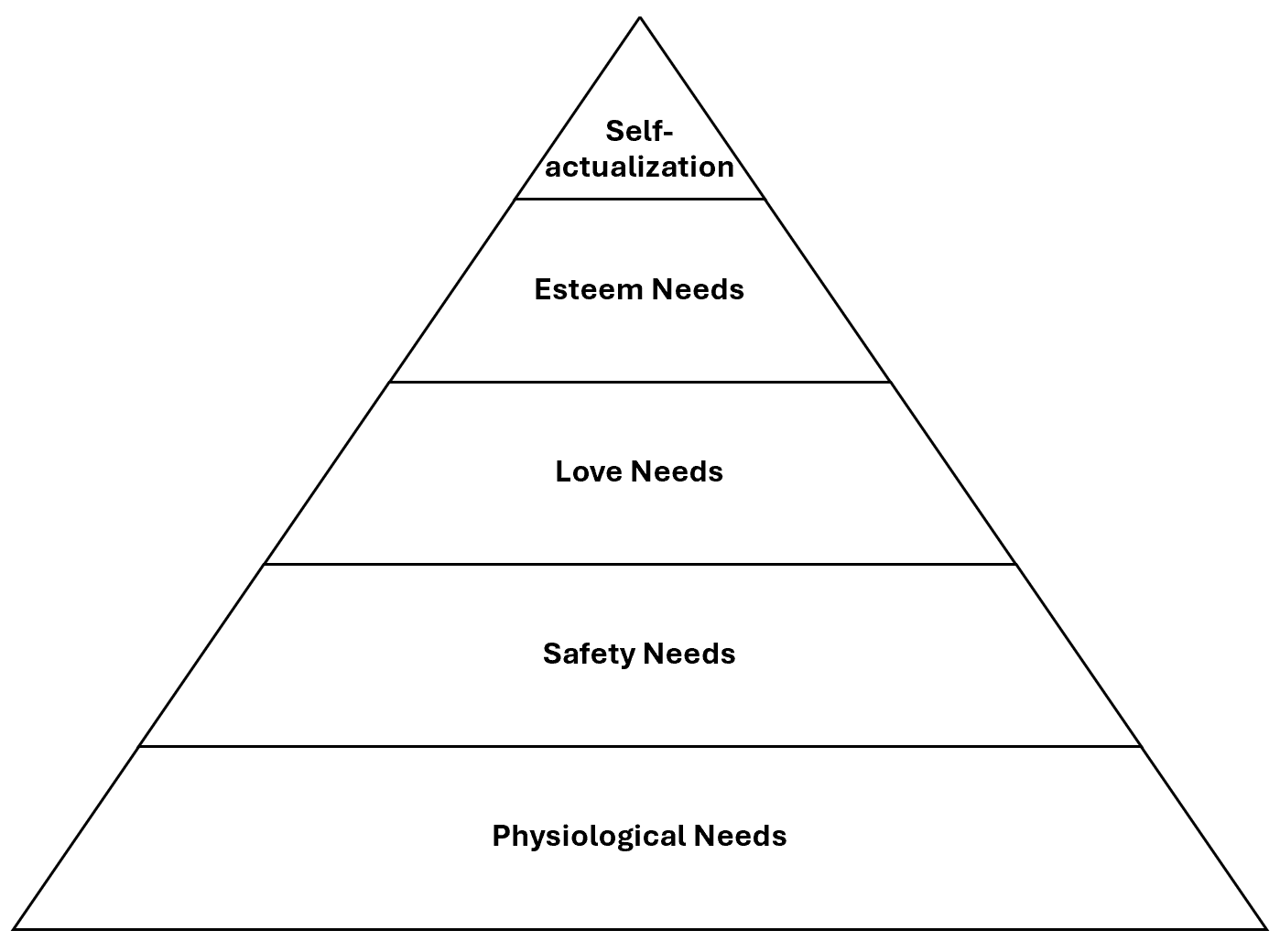
Maslow wisely kept his characterization of self-actualization general and open-ended, as there is no way to prescribe what is ultimately aspirational and inspirational. Also, relatively few people succeed in attaining to full self-actualization. Since “in our society, basically satisfied people are the exception,” Maslow claimed, “we do not know much about self-actualization, either experimentally or clinically.” Indeed, in all societies, the majority are too bogged down in tiring jobs and domestic burdens to devote time to contemplate the purpose to which they have been placed on this planet, let alone given the opportunities and encouragement to develop their talents to the fullest. This lopsided situation in which self-actualization is out of reach and irrelevant to all but a tiny minority has drawn accusations of elitism—an accusation sometimes unfairly leveled at polyamory itself (see, e.g., Harper, and retort by Chamberlin). Maslow has been critiqued for promoting a brand of New Age self-absorption and narcissism that places exclusive emphasis on individuals at the expense of community. On the other hand, if we allow that there are exceptions to Maslow’s hierarchy, so many in fact as to render the entire theory rubbish, the elitism critique is misplaced. How else do we explain the proverbial “starving artist” who wrenches works of genius out of his misery, or the rich traditions of folk art, produced by humans the world over and going back to the Neolithic Era, surviving under conditions of extreme indigence or starvation diets?
I regard Maslow’s hierarchy as a useful heuristic which is generally true, despite exceptions. It is also incomplete. Let’s return to polyamory and imagine a large polycule or communal family in which many people pass through, some residing on a more or less permanent, others on a more transient basis. Certainly, those with valued skills and vocations—e.g., doctors, farmers, chefs, lawyers, carpenters, mechanics, botanists, hunters, midwives, psychologists, jacks of all trades—would be the most welcome. So too would be painters, musicians, photographers, poets, dancers, teachers, and writers. One gains equally from a variety of perspectives through contact with expert practitioners, and all have roles to play in building the community. I would add two more essential roles: intimacy- and sex-providers. Those best suited to the teaching of intimacy would not necessarily be those whose job is to work with people—psychologists and therapists—but anyone with broad experience and expertise in nonmonogamous living. Unlike standard therapy, intimacy experts would not only be effective communicators but would instruct by example, by being intimate—call it virtuoso intimacy—with as many as possible.
Likewise, those best suited to the teaching of sex would not simply be sexual acrobats or those whose destiny is to sleep with a lot of people due to their being attractive, charismatic, and desirable. They would be more than that: erotic technicians imparting real sexual knowledge in, say, the tradition of dakinis, the female spirits or demonesses in Tantric Hinduism and Tibetan Buddhism who transmitted Kundalini energy through intercourse with human males. In his Sex, Drugs, Enlightenment: Noble Secrets from an Orthodox Buddhist ex-Monk, Alex Walking relates a relationship he had with a dakini-like (wholly human) “Red Tantra” woman skilled in the art of “Samadhi absorption”: “full-body orgasms complete with massive ejaculations of up to a half liter (two cups) or more of clear fluid, often repeatedly.” Incidentally, Walking and his Red Tantra partner made liberal, unabashed use of MDMA, LSD and cannabis, fusing erotic and psychedelic technologies of the body.
Those intent on being intimate and sexual with the largest number of people would do well to cultivate specific skills and techniques to impart as a gift to those gifting their own selves to them. Polyamory is fundamentally an act of generosity. Generosity of intimacy and sex is not easy for most people to grasp, however, straitjacketed as we are by the ideology of coupledom. It is easier to grasp if we regard free-flowing intimacy itself as a form of self-actualization. To put it another way, the polyamorous household or community enables and furthers self-actualization among its members through acts of generosity. Only through the mutual sharing of knowledge, expertise, and intimacy (including bodily intimacy) can people really evolve and grow. In other words, self-actualization begins to take shape among individuals in a very concrete and convincing way when it is empowered by the group and the community. For all his contributions to humanistic psychology, the reason why Maslow was short on details and procedures for self-actualizing is because he himself was straightjacketed by monogamy and couldn’t see beyond it. His hierarchy of needs might have taken a different shape had he experienced a functioning polyamorous community.
One way to revise the hierarchy is to leave Maslow’s hierarchy intact and add a sixth level above self-actualization: polyamorous self-actualization, or “poly-actualization” for short, which can be said to actualize, or maximize, self-actualization. The idea being proposed here is that polyamorous self-actualization arises through continuous and dedicated generosity among a community in all aspects of their lives, and this generosity deals in individuals’ various intellectual, romantic, and erotic capabilities. By itself, being polyamorous cannot achieve this; it is what one does through polyamorous work and what one learns from others through this work that is vital.
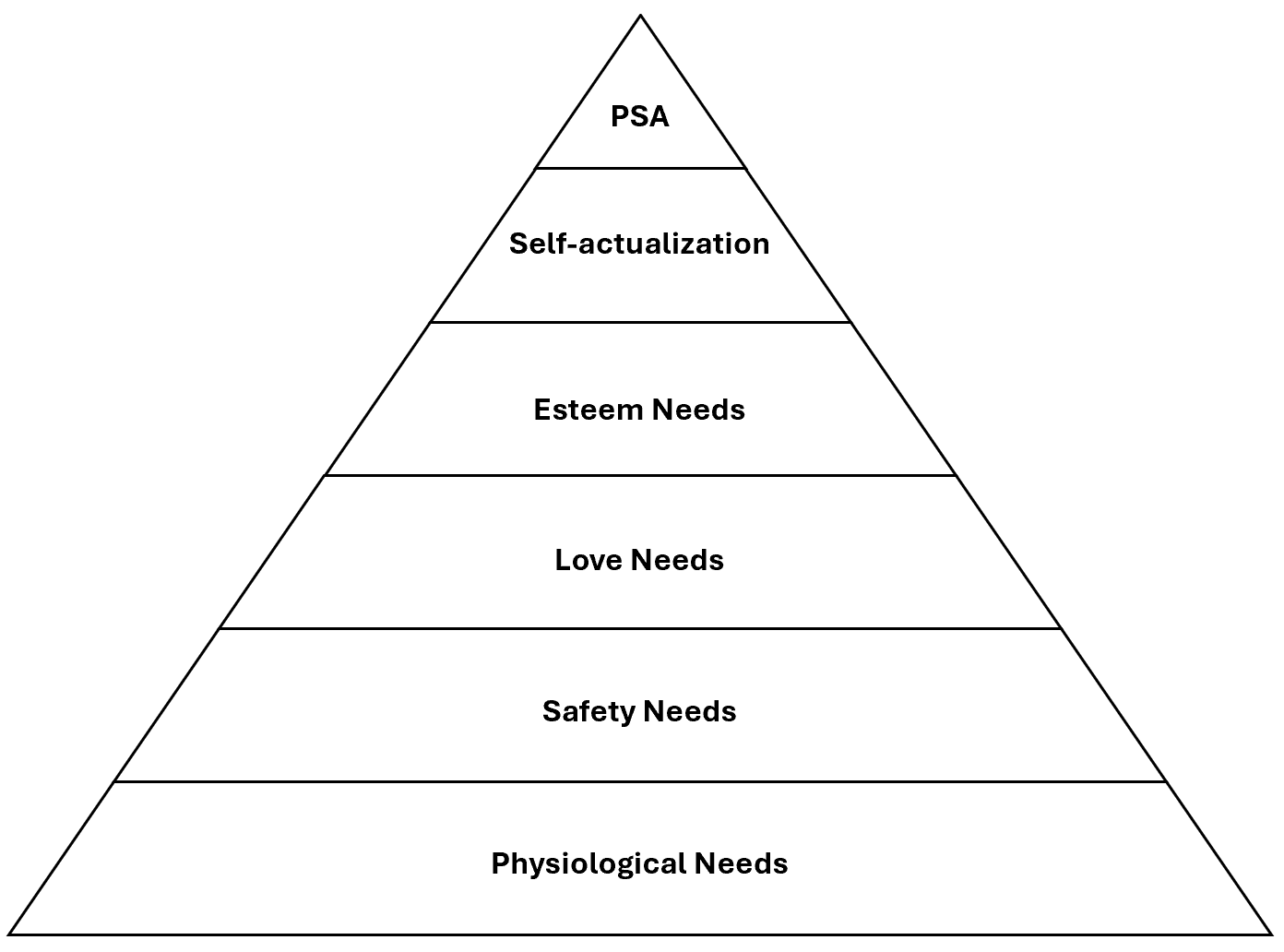
(PSA = Polyamorous Self-Actualization)
REFERENCES
Ambrose, Stephen E. Undaunted Courage: Meriwether Lewis, Thomas Jefferson and the Opening of the American West (Simon & Schuster, 2013).
Chamberlin, Brett. “Polyamory and the Ruling Class: A Response to The Atlantic,” OPEN (Organization for Polyamory and Ethical Non-monogamy) (April 30, 2024).
Eisner, Shiri. Bi: Notes for a Bisexual Revolution (Seal Press, 2013).
Engels, Friedrich. The Origin of the Family, Private Property and the State (Penguin, 2010).
Fern, Jessica. Polysecure: Attachment, Trauma and Consensual Nonmonogamy (Thornapple Press, 2020).
Fromm, Erich. The Art of Loving (Open Road Media, 2013).
Guiliani, Caroline Rose. “Love, Liberty, and the Pursuit of Polyamory: A Look Under the Covers of Nonmonogamy and Its Burgeoning Civil Rights Battle,” Vanity Fair (July 25, 2023).
Hardy, Janet, and Dossie Easton. The Ethical Slut: A Guide to Infinite Sexual Possibilities (Ten Speed Press, 2017).
Harper, Tyler Austin. “Polyamory, the Ruling Class’s Latest Fad,” The Atlantic (Feb. 1, 2024).
Kipnis, Laura. Against Love: A Polemic (Knopf Doubleday, 2004).
Krems, Jamie Arona, and Martie Haselton. “What really drives anti-abortion beliefs? Research suggests it’s a matter of sexual strategies,” The Conversation (June 23, 2024).
Leary, Timothy. The Politics of Ecstasy (Ronin Publishing, 1998).
Maslow, A. H. “A Theory of Human Motivation.” Psychological Review, 50 (4): 370–396 (1943).
Naquin, Susan. Millenarian Rebellion in China: The Eight Trigrams Uprising of 1813 (Dissertation, Yale U, 1974).
Reich, Wilhelm. The Invasion of Compulsory Sex-Morality (WRM Press, 2023).
Reich, Wilhelm. The Mass Psychology of Fascism (WRM Press, 2023).
Reich, Wilhelm. The Sexual Revolution: Toward a Self-Regulating Character Structure (WRM Press, 2023).
Requarth, Tim. “Abandon What You Think You Know About Polyamory. There’s Data,” Slate (May 5, 2024).
Ryan, Christopher, and Cacilda Jetha, Sex at Dawn: How We Mate, Why We Stray, and What It Means for Modern Relationships (Harper, 2012).
Sheff, Elisabeth. The Polyamorists Next Door: Inside Multiple-Partner Relationships and Families (Rowman & Littlefield, 2013).
Sommer, Matthew. Polyandry and Wife-Selling in Qing Dynasty China (U California Press, 2015).
Stanley, Jason. How Fascism Works: The Politics of Us and Them (Random House, 2018).
Thouin, Marie. What Is Compersion?: Understanding Positive Empathy in Consensually Non-Monogamous Relationships (Rowman & Littlefield, 2024).
Veaux, Franklin, and Eve Rickert. More Than Two: A Practical Guide to Ethical Polyamory (Thorntree Press, 2014).
Walking, Alex. Sex, Drugs, Enlightenment: Noble Secrets from an Orthodox Buddhist ex-Monk (Walking Publications, 2017).
* * *
Related posts by Isham Cook:
Transgressions: From porn to polyamory
Advanced love: An essay
My problem with the atheists (it’s not what you think)
A modest proposal regarding sex work: Why all sex should be paid for
Music for massage, meditation, sex, and psychedelics
Sexual Fascism: Essays
Also by Isham Cook:
THE TAO OF POISON
“The bold characters, kinetic plot, and rich sense of atmosphere make this epic tale a studied contemplation of how beauty can usher in tragedy and sorrow.” — BookLife Reviews by Publishers Weekly


 ISHAM COOK
Leave a reply to Isham Cook Cancel reply